


“Following a recipe is like building a house without adequate foundations, architectural plans or professional builders. In the dark”.
Michael Booth, “Sacre Cordon Bleu. What the French know about cooking”
Around 2 years ago in one American bookstores in Paris (Village Voice), I found a book, the title of which caught my eyes straight away: “Sacré Cordon Bleu. What the French know about cooking” by Michael Booth, a travel writer and journalist. Michael had moved to Paris to study at Le Cordon Bleu, after having burnt all cookbooks except for Ma cuisine of Auguste Escoffier's. This intelligently, very informative, non pretentious and funnily written book describes his culinary adventures in Paris and in this cooking school. He decided to study the Culinary Art Program, after numerous failures in following cookbooks’ recipes which did not help him to acknowledge techniques and had not empowered him to cook.
Do you share this opinion that, if you strictly follow a recipe, you have a great chance of failure to burn your meat, to dry out your chicken in the oven, to spoil your crème patissière and to overcook your risotto? But in particular, as regards complicated preparations and complex dishes, cookbooks are even less helpful; because they fail to explain the recipe exactly at the moment where a problem starts (it is the same with books for lawyers usually). Why it is that, beginner cooks so often complain about their failures when following cookbooks’ recipes? In my case, the biggest practical knowledge I gained comes from my husband, who, when he was younger, spent years as a cook and a pastry chef in French restaurants in Los Angeles and New York City. He taught me such obvious and non obvious things like to put a dump paper towel under your cutting board once you chop and slice; he showed me professional cutting techniques and some preparations; he supervised me on how to organize your working table and kitchen without making a mess (although, still, it does not always work) and he gave me lessons of homemade veal stock, for example.
Those few ideas that Michael Boot gives in the introduction to his book, are remarkable.
“…The failings of recipe books are inevitable; however it is not the writers’ fault.
Most cookbooks are written with the best intention at heart, usually by highly skilled cooks, and their recipes are properly tested, but how can Jamie Oliver possibly know the exact condition, size, ripeness, tenderness or colour of the ingredients you will be using?
How they can know how efficient your oven is or how cold your fridge is? How they can know how thick your frying pan is, or the quality of meat you are using?
How do they know temperature of your kitchen, or whether you like to cook with a window open, that your Kenwood has seen better days and doesn’t quite whisk the gusto it once had, or that your grill is so caked in grime that it can barely muster half the heat it ought to?...
….And these are merely the issues that plague the well – written, thoroughly tested recipe books. What about all those cobbled together recipes in the back of women’s magazines and the Sunday supplements, or those dodgy posting on the Internet, on blogs and notice boards that many home cooks have started to use more and more?
Some times recipes do work, of course, but those occasions are, I suspect, more to do with a blessed alignment of the culinary planets than any rigorous intent on the part of the cookbook writer. But even when recipes do work, cookbooks rarely, if ever, empower you to cook. It took me years of harrowing kitchen failures to realize that this, but a proper cook knows techniques rather than formulas; a proper cook can look at a plate of raw ingredients and conjure an infinite repertoire of dishes. A proper cook, I eventually convinced myself, needs just one cookery book: Auguste Escoffier’s Ma cuisine…”
And as regards today's recipe: at the beginning of my blogging experience I wrote about Pierogi and I presented two popular and rustic versions of this dish: a savory cheese-potato-onion version “Pierogi Ruskie” and a sweet version "Pierogi with Bilberries".
The Pierogi concept, or rather the idea (like Italian raviolis, for example), has endless opportunities for experiments with various stuffing. But during decades of a communism regime we could only “enjoy” their more simple rural versions. Pierogi with meat fillings are one of the most common versions and you will find them in nearly every food shop (frozen or cooked), fast food bars at gas stations, cantinas and restaurants. Pork meat is often used for stuffing, but beef and veal are used as well. However you can use any type of meat you desire: chicken, turkey, duck, lamb. You may even use fish as well. Traditionally, meat is firstly baked or cooked (you can use leftovers from dinner), and then grind it before stuffing. When I was a teenager, I called Pierogi with meat “a review of a week”. One could never be sure what type of meat leftovers had been used for stuffing in a school cantina or a low quality bistro at a railway station.
For a long time, I had in my mind the idea of Pierogi stuffed with lamb’s meat (easy to buy in France) and served with fresh morels (or at least, frozen ones - those one can find in every Picard store). So when the morel season started last month and when I saw those fresh mushrooms at our food market on boulevard Raspail, I agreed to ruin my daily food budget and decided to buy a small quantity of them (because they are so expensive, if I remember well, around 120 € per kilo). The season for fresh morels is short. That’s why you can use frozen or dried ones (dried morels can be reconstituted by soaking them in water). Eventually, you can experiment with other forest mushrooms.

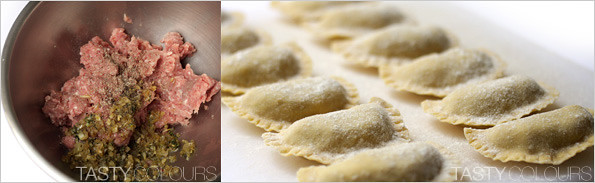
This time, instead of preparing my Pierogi the traditional way, I stuffed my dumplings with raw, ground meat, the way Russian Pelmeni are done. The main reason for doing so was that I wanted to avoid spoiling this delicious lamb meat by cooking it twice.
We served them with a homemade Demi-Glace (I will share with you this great recipe in one of my following posts). I realize that veal stock is a kind of preparation that it is difficult to make at home (for example, in some countries you will not get any veal bones in any store) and those industrial powdered stocks are hopeless. The authentic, homemade veal stock itself may not be very interesting in taste. But what is fascinating about it, once you combine it with other flavors, like for example, the juice from these lamb’s pierogi, it becomes something absolutely outstanding. If you do not have homemade veal stock, feel free to use just mushrooms, some extra melted butter, some more fresh thyme and some hard, grated cheese (I used some Oscypek, but every hard, sheep’s cheese, will be good). You can serve them eventually just sprinkled with some fresh, chopped mint, if you do not like mushrooms.
Dumplings (Pierogi) with Lamb, Morels and Demi-Glace
Serves 4 (makes between 30-40 Pierogi depending on their size)
Ingredients:
440 g Pierogi Dough
500 g ground raw lamb meat
3-4 medium shallots, peeled and finely chopped
2 garlic cloves, peeled and finely chopped
2 tablespoons fresh thyme
200 g fresh morels (optionally, you can use dried or frozen)
50 g grated Oscypek or any other hard, salty sheep’s cheese (optional)
200 ml homemade veal stock (optional)
3 tablespoons olive oil
2 tablespoons butter
Salt
Pepper
Preparation:
Start with the preparation of morels. Clean them delicately, wash them and dry them out with a paper towel.
In a hot frying pan, add olive oil and fry shallots, after five minutes add garlic and thyme and fry until gold on a medium flame. Mix often and do not let them burn.
Put aside.
In a bowl, mix lamb’s meat with fried shallots, garlic and thyme. Salt and pepper.
Mix everything delicately and taste.
Put the filling aside and, in the meantime, prepare pierogi dough as described in the basic recipe. You can roll out the dough a bit thicker (you will stuff your Pierogi with raw meat and they have to be cooked a bit longer than normally).
Once Pierogi are ready for cooking, put them aside (be careful, they should not stick to each other) and cover them with a dish towel (so they will not dry out).
In a large saucepan, bring to a boil 4 liters of water and add a bit of salt.
In the meantime, in a hot frying pan, melt butter and add a bit of olive oil. Fry mushrooms on a quite high flame, until gold.
Pour the veal stock into a small saucepan and reduce it to around 2/3 of its volume. To intensify the stock’s flavor, you can put one or two morels into it few minutes before the end of reduction.
Once your sauce and mushrooms are ready, add Pierogi (but remove the table cloth, of course) into boiling water (10 to 15 pieces at a time). Cook Pierogi about for 5 minutes. The best way to check whether the meat is cooked is to take one dumpling and simply taste it.
Serve immediately with the warm veal stock and morels, sprinkled with a bit of grated cheese. These Pierogi also taste wonderful when grilled for a few minutes after cooking.
Cost:
Lamb – 11 €
Morels – 24 €
Remaining ingredients (flour, eggs, thyme, shallot, garlic, a bit of cheese) - 2 €
Veal stock – we had some in stock in our freezer (anyway, you do not buy bones in France, you get them for free)


0 Yorumlar